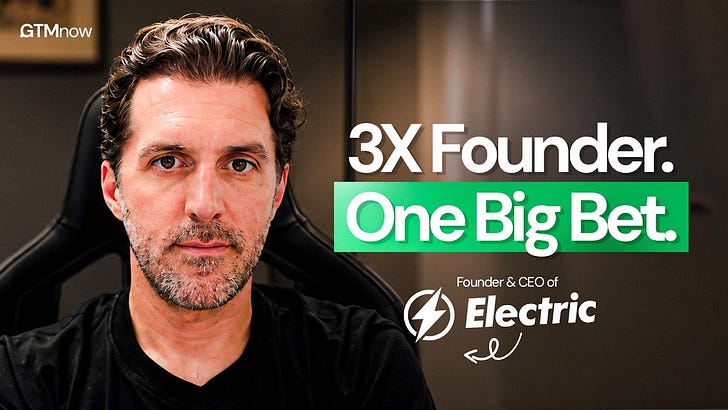
Listen on YouTube // Apple // Spotify
Who you’ll learn from
Chris McDonough has joined 4 companies right before they exploded. At the first, Motive, he was employee 40 and watched revenue go from $800K to $30M in about 100 days. The VP of Sales at Campfire joins Sophie Buonassisi on GTMnow to break down what he learned riding hypergrowth over and over, and why he thinks AI is about to split the sales profession in two.
Chris gets tactical on the whole arc: how a two-week decision to sign a lease and move to SF changed his trajectory, what a federal mandate taught him about compelling events, why your career growth is tied directly to how fast your company grows, and how he now builds an AI-native sales org from scratch at Campfire (an AI-native ERP taking on the legacy giants). He also makes the contrarian case that AI won’t replace reps but will widen the gap between them, why AI outbound is mostly spam for complex B2B, and why a strong SDR bench is existential.
What you'll learn:
The $800K-to-$30M-in-100-days story, and what a compelling event really looks like
Why your career trajectory is tied to your company’s growth rate (”you can’t be a VP if there’s no one to be VP of”)
The contrarian AI take: not labor replacement, but a top 30% worth triple and a bottom 20% that’s hard to employ
What he hires for now: not just skill, but whether you can self-learn from AI on day one
How to build an AI-native sales org with no tech debt (the deal dashboard that grades every call against every win and loss)
Why AI outbound mostly becomes a spam tool in complex B2B, and why the SDR bench matters more
Why he leaves once a company is big enough to run Workday, and goes back downmarket
How to sell into the “real economy,” where nobody cares about your hot VC and references are hyper-local
Regrettable churn: the retention metric behind Samsara’s run, and why top reps compound
One-way vs. two-way doors: how to make fast decisions at 70-80% of the data
Episode highlights
01:17 - Welcome, and a career of joining companies right before they explode
01:51 - Employee 40 at Motive, and the two-week decision that changed everything
04:19 - The federal mandate, and the hiring class that got promoted in 30 days
05:33 - Why career growth is tied to company growth rate
07:12 - The mandate story: from selling nothing to 70 demos a week
10:19 - Was it the wrong decision? Believing through the objection
10:56 - What 800-900 demos in 3 months does to a seller
12:11 - Samsara: scaling an office 0 to 100, and 250 interviews in 90 days
13:42 - The contrarian hiring philosophy: the 10x seller and the widening gap
15:59 - Why he left Rippling for Campfire, and the "Workday rule"
18:41 - Building an AI-native sales org with no tech debt
21:14 - What Campfire is: AI-native ERP and one of software's last moats
25:25 - Expanding the TAM and the recession-proof case
26:12 - Selling into the real economy: hyper-local references, not hot logos
28:26 - His honest take on AI outbound and AI SDRs
30:49 - The SDR org as your existential talent bench
31:56 - The metric he obsesses over: regrettable churn
33:45 - Who Campfire is hiring, and "will Claude kill this company?"
35:33 - Rapid fire: leadership, execution over competitors, one-way vs. two-way doors
40:19 - Where to find Chris, and how to actually DM your way into a job
Key takeaways
1. Your career trajectory is tied to your company’s growth rate, so join the explosion.
Chris joined Motive (then KeepTruckin) as employee 40 and took the hiring class starting in two weeks instead of six. That single choice compounded enormously: everyone in his class was promoted to AE in 30 days, while the six-weeks-later class waited 18 months. In that same window he went from SDR to interim director running a large team in Nashville. His blunt advice: assuming equal talent and work ethic, the fastest way to accelerate a career is joining a company in hypergrowth, because “you can’t be a VP if there’s no one to be a VP of.” New markets, new segments, and leadership seats only open when the company is expanding fast.
2. Reps and volume build the muscle, and a compelling event is gold.
Motive sold almost nothing from May to September 2017 because truckers believed the incoming administration would kill the federal ELD mandate (it never was in doubt). Chris held conviction through the objection because he didn’t believe it was real. When the December deadline got real, demand became insatiable: he did 70+ demos a week, blocked his calendar just to eat and use the bathroom, and the company went from $800K to $30M in about 100 days (roughly $100M by the time he left). The lesson beyond the number: a legally mandated purchase is the ultimate compelling event, and doing 800-900 demos in three months compressed years of rep-building into weeks.
3. AI won’t replace reps, it’ll widen the gap, and that reshapes hiring.
Chris’ contrarian belief mirrors the “10x engineer” becoming the “100x engineer”: AI makes top performers exponentially more productive, so he expects a core 30% of salespeople worth triple everyone else and a bottom 20% who become hard to employ. That changed what he hires for. Raw skill and work ethic still matter, but the differentiator now is whether someone can self-learn: at Campfire, Claude is wired into everything, so a new rep can mine calls, demos, and insights on day one instead of waiting for knowledge locked in someone’s head. He’s also candid that he left Rippling partly out of a personal fear he wasn’t developing AI-native skills fast enough to stay employable, the same fear he thinks reps everywhere should take seriously.
4. Building AI-native means no tech debt and ruthless tool integration.
Starting fresh at Campfire, Chris designs the stack around how tools talk to each other, testing the quality of each tool’s MCP and assuming most will become “headless.” His flagship example: an automation that listens to every call, enriches the deal in the CRM via Clay, and grades it against every closed-won and closed-lost deal the company has ever had, producing a daily top-deal dashboard tied to battle cards that also flags when a champion leaves or a new VP appears. It kills the two-hour manual QBR deck, because every call is already listened to and every deal already scored, freeing managers to coach faster. On the business itself: he argues ERP is one of software’s last moats because the data is audited and correct (unlike messy CRM data), which makes it both defensible from “will Claude build this?” fears and a strong long-term foundation for AI workflows.
5. Build a strong SDR bench and obsess over regrettable churn.
Chris is skeptical of AI outbound: in complex B2B it mostly becomes a spam tool with very low conversion, useful only for transactional/low-end deals. The companies that win, in his view, invest in a real SDR org that becomes the talent bench, his ideal is hiring an SDR he promotes to director years later (at Rippling, nine of twelve directors were once AEs). Internal promotes ramp faster, attain higher, and are less risky, and a visible promotion track is a recruiting magnet. The metric he tracks most fiercely beyond revenue and pipeline is regrettable churn: he credits Samsara’s $100M-to-$1B IPO run to barely losing a single top rep, because top performers compound over years (the top 30-40% often carry 70-80% of the number). Two bonus frames worth stealing: sell into the “real economy” with hyper-local references (an oil-and-gas buyer in Texas wants to hear about another Texas oil-and-gas customer, not your hot SF logo), and use Bezos’ one-way vs. two-way door test to move fast at 70-80% of the data.
Chris McDonough
Campfire: https://campfire.ai (Campfire is roughly 2–3x’ing its GTM org by the end of the year. Chris is hiring SDRs, AEs, and SEs, plus leaders for each of those departments - aggressively across the stack to keep up with market demand. If you’re interested in a role in NYC, San Francisco, or London, check out the Campfire careers page!)
Sophie Buonassisi (Host)
X (Twitter): https://x.com/sophiebuona
Newsletter:

GTMnow
LinkedIn: https://www.linkedin.com/company/gtmnow
X / Twitter: https://x.com/GTMnow_
YouTube: https://www.youtube.com/@GTM_now
Instagram: https://www.instagram.com/gtmnow_
TikTok: https://www.tiktok.com/@gtmnow_
The GTMnow Podcast - subscribe to support
It would mean the world to us if you subscribe to the show on your platform of choice. This helps support our growth, which in turn helps us continuously bring on bigger guests and deliver the content that you want to hear most.
The GTMnow Podcast shares how the best in tech build, scale and invest.
Visit gtmnow.com for more episodes, The GTMnow Newsletter editions, and other content.
GTMnow is run by GTMfund, an early-stage venture firm made up of 350+ go-to-market executives from the fastest-growing companies.